NEWS

Featuring expert voices driving equitable policy reforms across Kenya
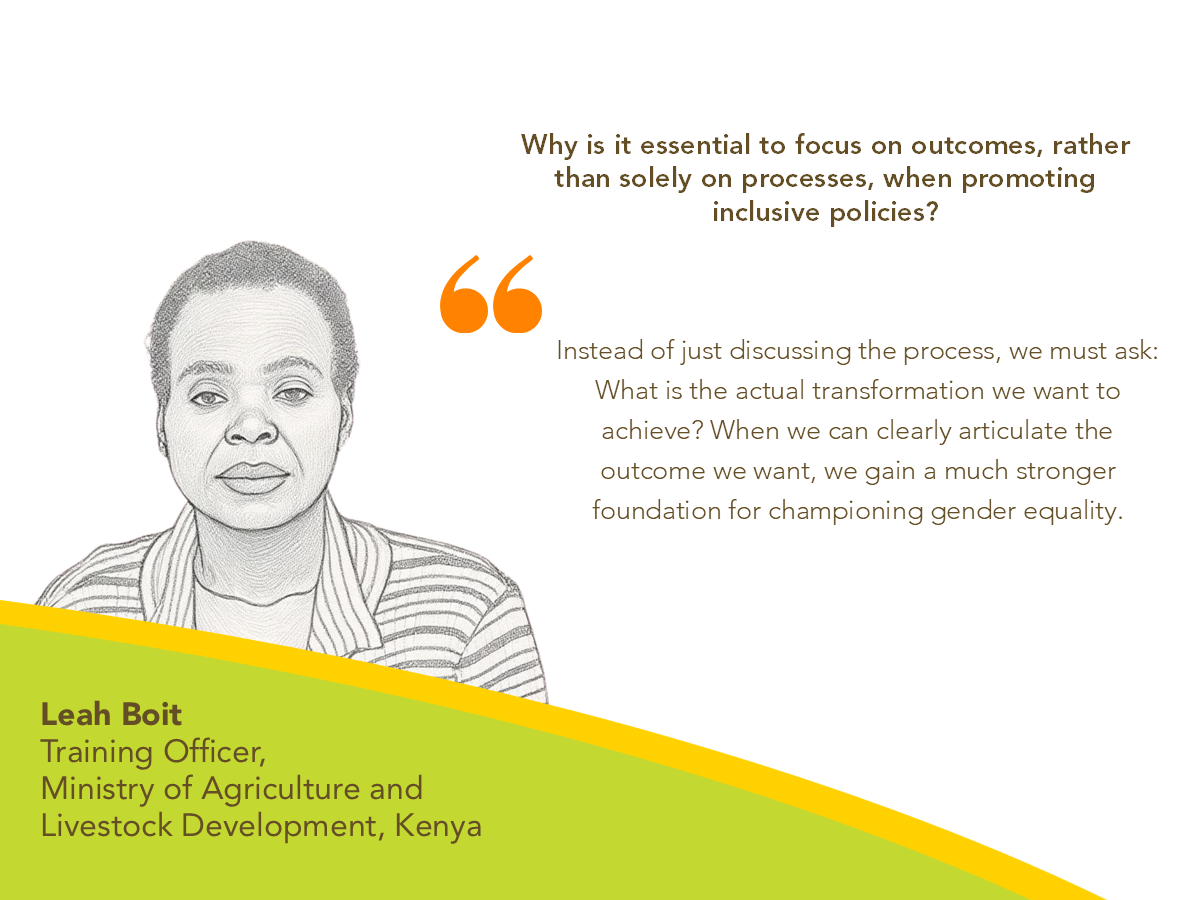
This feature spotlights Ms. Leah Boit, Training Officer, Ministry of Agriculture and Livestock Development, Kenya. She reflects on the importance of clearly defined policy outcomes in building a stronger foundation for advancing gender equality.
Name: Leah Boit
Title: Training Officer
Institution: Ministry of Agriculture and Livestock Development, Kenya
Q: What lessons from the training did you find most valuable for your work, and how do you plan to apply them?
Leah: My role involves training, and part of that includes mainstreaming cross-cutting issues like gender. For a long time, we’ve struggled to communicate why gender mainstreaming matters in our sector. What struck me during the GASP training is that, despite our constitutional requirement to mainstream gender in all departments, we haven’t truly achieved that commitment.
One key takeaway for me is the importance of focusing on outcomes. Instead of just discussing the process, we must ask: What is the actual transformation we want to achieve? When we can clearly articulate the positive outcomes, such as increased productivity or improved family nutrition, we gain a much stronger foundation for championing gender equality.
Q: What challenges do you find impact gender integration in agrifood policies the most?
Leah: For me, the biggest challenge is facilitation and structure. Ideally, all our departments should have a dedicated gender expert, but that is not the case, which makes gender mainstreaming feel like an add-on rather than a core part of our work. Without proper structures and dedicated resources, our efforts remain broken and lose momentum.
Q: What opportunities does the GASP program create to tackle them?
Leah: Through the program, we are shifting from theory to practice. The training has provided us with a network of professionals who are not only theoretically trained but also have practical experience. For instance, we’re learning practical gender analysis tools that an extension officer can use. Something as simple as considering the timing of a training session can determine whether women can attend. This program is building a community of competent professionals who can design practical interventions that fit into the community’s rhythm, ensuring that no one is left behind.
Q: Tell us one fun fact about your job.
Leah: I love fieldwork, especially food security assessments. I ask smallholder households how many meals they eat a day. Often, the answer is one or two. But when I ask how many they’ve eaten on average for the last five years, they give the same answer. It’s a striking moment. What we as outsiders see as insufficient for their dietary needs, they have come to regard as their ‘normal’. It’s a reminder that our perception of ‘normal’ can mask deep-rooted food insecurity, and that my work isn’t just about data. It is about changing perspectives and realities to ensure that ‘normal’ truly meets people’s needs.