NEWS

Featuring expert voices driving equitable policy reforms across Kenya
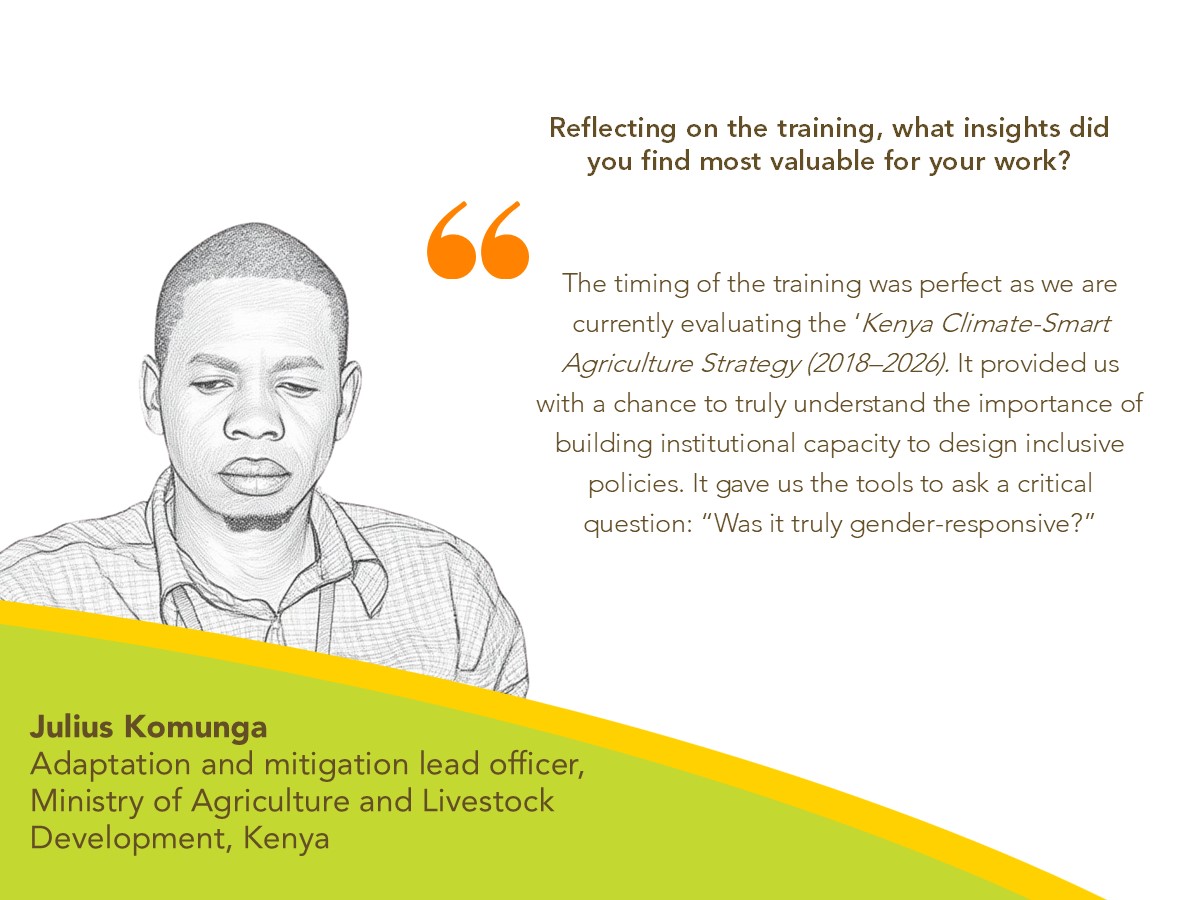
This feature follows an interview with Mr. Julius Komunga, Adaptation and mitigation lead officer, Ministry of Agriculture and Livestock Development, Kenya. He shares insight on the importance of integrating gender in policy design and practice.
Name: Julius Komunga
Title: Adaptation and mitigation lead officer
Institution: Ministry of Agriculture and Livestock Development, Kenya
Q: Reflecting on the training, what insights did you find most valuable for your work?
Julius: This was a space for learning and sharing across diverse perspectives, from academia, research, and other government departments. The timing was perfect, especially as my department is currently evaluating the ‘Kenya Climate-Smart Agriculture Strategy (2018–2026)’. The training emphasized the importance of gender analysis and building institutional capacity to design inclusive policies. This training equipped us with the tools to ask a critical question: “Was it truly gender-responsive?” More importantly, it gives us the know-how to ensure the following strategy is.
Q: What challenges do you find impact gender integration in agrifood policies the most?
Julius: It is a combination of issues. Women often have limited access to credit, technology, and agronomic information, including early warnings. But perhaps the most critical challenge is their underrepresentation in decision-making platforms, such as cooperatives. This means their voices aren’t heard where it counts. Additionally, gender policy implementation is uneven across counties coupled with a capacity gap among public and private actors responsible for putting them into practice.
Q: What opportunities does the GASP program create to tackle them?
Julius: The program provides a strong foundation for ensuring that our policies are inclusive and sustainable, ultimately benefiting the entire community. It provides us with the tools to empower smallholders, particularly women, throughout the entire value chain, ensuring they are well-informed and resilient, especially in the face of climate change. The tools we’ve gained are a major step towards “gender-proofing” our climate and agriculture policies, which are fundamental for national food security. Additionally, the program is a catalyst for cross-collaboration, creating spaces for knowledge exchange and shared learning.
Q: Tell us one fun fact about your job.
Julius: (Laughs) In this sector, I like to call myself a jack of all trades. I’m involved in everything from policy development and capacity building to stakeholder partnerships and climate change adaptation; it all lands on my desk. It’s challenging, but it means I get to see the entire picture, from the policy document to its impact on the ground. That is incredibly rewarding!