NEWS

Fostering Equitable Agrifood Systems Driven by Gender-Responsive Policies
Featuring expert voices driving equitable policy reforms across Kenya
AWARD, through its Gender in Agrifood Systems Policies (GASP) Program, is intensifying its efforts to promote gender integration in agriculture policies. The GASP program offers tailored interventions for individuals and institutions to enhance their capability to interrogate agricultural policies and institutional practices to identify ways of addressing gender gaps and opportunities for equitable agrifood policies.
Since its launch in June 2025, the GASP program has worked with 45 institutions from eight countries and trained a total of 185 participants on gender and agrifood policies. The training was designed to equip the participants with tools and approaches for conducting gender gap assessments and developing action plans to address the gaps.
The series features six participants from Kenya’s Ministry of Agriculture and Livestock Development and AMKA Africa Justice Initiative who share their key takeaways from the training and insights about their work.
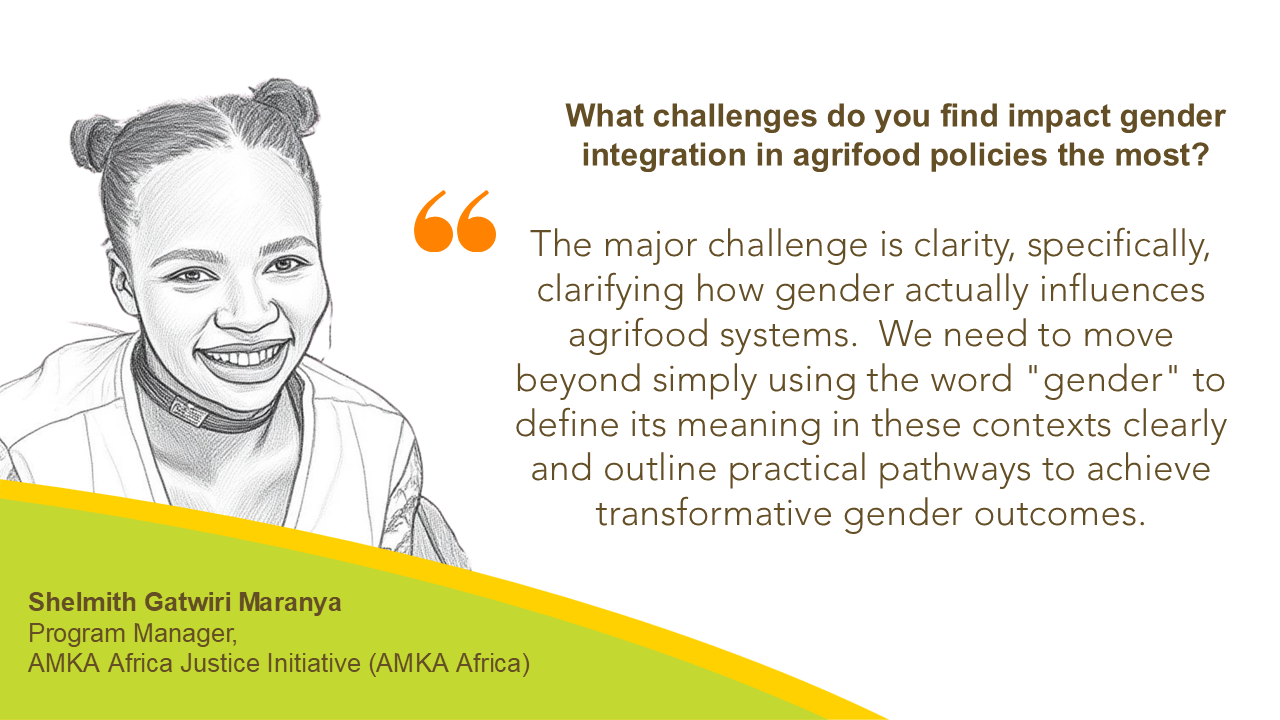
In this feature we spotlight Ms. Shelmith Gatwiri Maranya, Program Manager, AMKA Africa Justice Initiative (AMKA Africa).
Name: Shelmith Gatwiri Maranya
Title: Program Manager
Institution: AMKA Africa Justice Initiative (AMKA Africa)
Q: What lessons from the training did you find most valuable for your work, and how do you plan to apply them?
Shelmith: The most valuable lesson for me has been learning how to conduct policy analyses that systemically integrate gender into every stage of our work, from policy and program analysis right through to monitoring and evaluation. For an organization like AMKA Africa, which focuses on access to justice and policy advocacy, these are not just academic concepts. These are new and practical tools we can immediately apply to make our work more impactful and meaningful.
Q: What challenges do you find impact gender integration in agrifood policies the most?
Shelmith: I find that the major challenge is clarity, specifically, clarifying how gender actually influences agrifood systems. We need to move beyond simply using the word “gender” to define its meaning in these contexts clearly and outline practical pathways to achieve transformative gender outcomes.
Q: What opportunities does the GASP program create to tackle them?
Shelmith: The program broadens our understanding and breaks down these complex concepts into actionable strategies. For example, what we learned about sex-disaggregated data has completely shifted our perspective on program monitoring. It forces us to ask new questions and view our programs from a much broader perspective, measuring real impact more effectively.
Q: Tell us one fun fact about your job.
Shelmith: The highlight of my work is seeing direct success stories. There’s nothing like witnessing someone win a court case for a title deed, finally giving them secure access to their land and the power to improve their life. That is life-changing! Or knowing someone accessed critical information through us that changed their future. That’s justice delivered, translating into empowerment!
Discover more stories from the GASP program!