NEWS

Featuring expert voices driving equitable policy reforms across Kenya
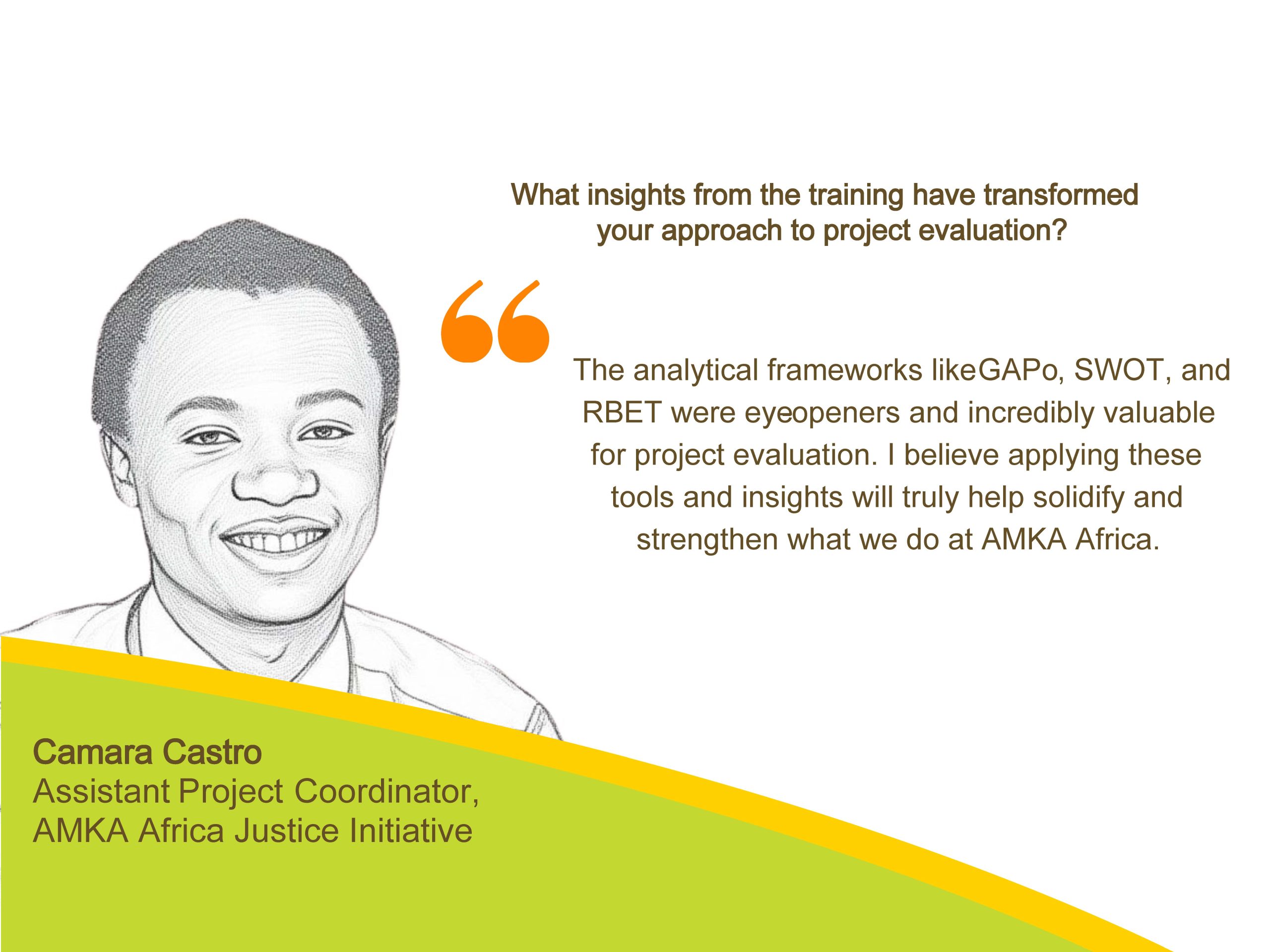
In this third feature, we talk to Mr. Camara Castro, Assistant Project Coordinator, AMKA Africa Justice Initiative, Kenya who shares his insights on the significance of gender integration in project evaluation.
Name: Camara Castro
Title: Assistant Project Coordinator,
Institution: AMKA Africa Justice Initiative (AMKA Africa)
Q: What insights from the training have transformed your approach to project evaluation?
Camara: The analytical tools have been an eye-opener. I found frameworks like Gender in Agricultural Policies (GAPo), Strengths, Weaknesses, Opportunities, and Threats (SWOT), and Reach-Benefit-Empower-Transform (RBET) incredibly valuable for project evaluation. They will help us precisely identify our beneficiaries and measure the direct outcomes of our work. Another critical lesson is that the impact of organizational structure on a project’s success can be a powerful positive force or a significant hindrance. I believe applying these tools and insights will truly help solidify and strengthen what we do at AMKA Africa.
Q: What challenges do you find impact gender integration in agrifood policies the most?
Camara: One of the biggest challenges is that gender integration is often misunderstood. For instance, while analyzing the draft gender and agriculture policy—a tool designed to guide Civil Society Organizations like ours—some aspects lacked clarity. When policy frameworks are not clearly articulated, organizations struggle to align effectively, making them a barrier rather than a solution. So, there’s an urgent need to make such frameworks more straightforward to ensure meaningful gender integration in agrifood systems.
Q: What opportunities does the GASP program create to tackle these challenges?
Camara: The training challenged us to rethink our internal systems and approach to project evaluation. For instance, on day two of the training, we mapped our organizational culture and learned which specific tools to use for project evaluation. We learned that the GAPo tool is exceptional for clarifying our purpose and measuring progress more effectively. Personally, the training has equipped me to return and initiate meaningful conversations with my team about our goals and align them to achieve tangible impact.
Q: Tell us one fun fact about your job.
Camara: The most exciting part of my job is how our organizational culture makes my job efficient and rewarding. At AMKA Africa, we have zero bureaucracy. Meaning, I can access my seniors at any time, which makes my job a fantastic learning experience. The teamwork and lack of red tape not only make work enjoyable and fulfilling, but they also ensure that we deliver our projects with maximum efficiency.